Views: 25 Author: Printbar Publish Time: 05-29-2026 Origin: Site


Fountain solution does one job: it keeps the non-image areas of the plate wet so the ink stays where it belongs. It is an acidic water-based mix. If the chemistry drifts even a little, the ink spreads into places it should not touch. A shift that started clean turns into scummed plates and wasted paper. That is why choosing the right fountain solution for offset printing is not a lab decision. It is a pressroom one — and for pressroom chemicals, the line between stable production and wasted stock is thin.
On a high-speed press running 15,000 sheets an hour, small problems multiply fast. Holding pH, conductivity, and temperature inside a narrow window is what keeps the run predictable. This reference covers everything that goes into that window, from the raw chemistry to the daily troubleshooting — whether you are evaluating a china fountain solution for import or comparing domestic brands.
Table of Contents
The name comes from the "water fountain" or "water pan" on a lithographic press. That is the reservoir that holds the fluid and feeds the dampening rollers. In Chinese it is 润版液 (Rùnbǎnyè), literally "plate-wetting liquid."
You will also hear "dampening solution for offset printing," "dampening water," or historically "fountain etch." Fountain etch originally meant the strong acid concentrate used to treat metal plates. Today "fountain solution" means the diluted, ready-to-use working fluid circulating through the press.

Lithography started in 1796 when Alois Senefelder printed from Bavarian limestone using plain water to repel greasy ink. Plain water worked on stone. It stopped working when the industry switched to high-speed rotary presses for offset lithography, using zinc and aluminum plates in the late 19th and early 20th centuries. Metal plates oxidized. Water evaporated too fast to keep non-image areas clean.
Pressmen started adding acid "etches" with natural gum arabic and weak phosphoric or citric acid. The mix desensitized the non-image aluminum areas, building a water-receptive metal oxide layer that held up under speed.
The next big change came in the 1960s with isopropyl alcohol (IPA) as a wetting agent. At 10 to 15 percent concentration, IPA let printers run an exceptionally thin, even water film on the plate with no splattering. Print speed and sharpness jumped.
By the late 1990s, environmental rules, VOC taxes, and health concerns over breathing IPA fumes pushed the industry toward alcohol-free fountain solutions. Today's concentrates use synthetic surfactants to match what IPA did, without the fire hazard and the emissions.
Water makes up 95 to 99 percent of what actually runs through the press. The remaining 1 to 5 percent is a chemical concentrate — fountain solution concentrates, as the industry calls them — built from twenty-plus raw materials. Each component has a specific job. Take one out and something breaks.
Acid and buffering systems. Weak organic or inorganic acids, usually phosphoric or citric, lower the pH to convert the desensitizing gum into its active free-acid form. Alkaline paper coatings and ink chemistry can shift pH during a run, so a buffer system (citric acid plus sodium phosphates is common) holds the pH inside a narrow window.
Desensitizing gums. Natural gum arabic or synthetic polymers like carboxymethyl cellulose bind to the micro-porous aluminum oxide surface of the plate. They continuously replenish the hydrophilic layer that repels ink.
Wetting agents (surfactants). Glycols, glycol ethers, or polyether-modified polysiloxanes lower the surface tension of the water. That lets it spread quickly and evenly across the plate instead of beading up.
Corrosion inhibitors. Salts like ammonium citrate or magnesium nitrate stop the acidic water from eating into the aluminum plate, steel rollers, and iron press frame.
Biocides. Industrial preservatives that keep algae, fungi, and bacteria from growing in the warm, wet recirculation tanks and water lines.
Defoamers. Anti-foaming agents that stop air bubbles from building up as the solution gets churned by the circulation pumps.
Fountain solutions are grouped by VOC content, specifically how much isopropyl alcohol they need or do not need. The type you pick determines your emission profile, your fire risk, and how the pressroom smells at the end of a shift.
Type | IPA content | Key characteristics | Typical use |
|---|---|---|---|
IPA-based (traditional) | 8% to 15% | Fast wetting, high evaporation, flammable | Legacy sheet-fed and web presses |
Alcohol-reduced | 3% to 5% | Reduced VOCs, moderate wetting speed | Transitional shops phasing out IPA |
Alcohol-free | 0% | Surfactant-driven wetting, zero VOC, non-flammable | Modern commercial and packaging presses |
UV-specific | 0% | Restricts water pickup by UV ink, prevents cure inhibition | UV and LED UV offset printing |
The fountain solution in offset printing creates a chemical boundary on the printing plate surface, governed by the interfacial tensions between ink, water, and metal. Young's Equation describes the relationship:

Where γsf is the interfacial tension between the solid plate and the fountain solution, γsi is the tension between plate and ink, γfi is the tension between fountain solution and ink, and cosθ is the contact angle of the solution on the plate surface.
For clean printing, the contact angle of the fountain solution on the non-image area must approach zero. The solution has to wet the plate completely and form a barrier the ink cannot cross.
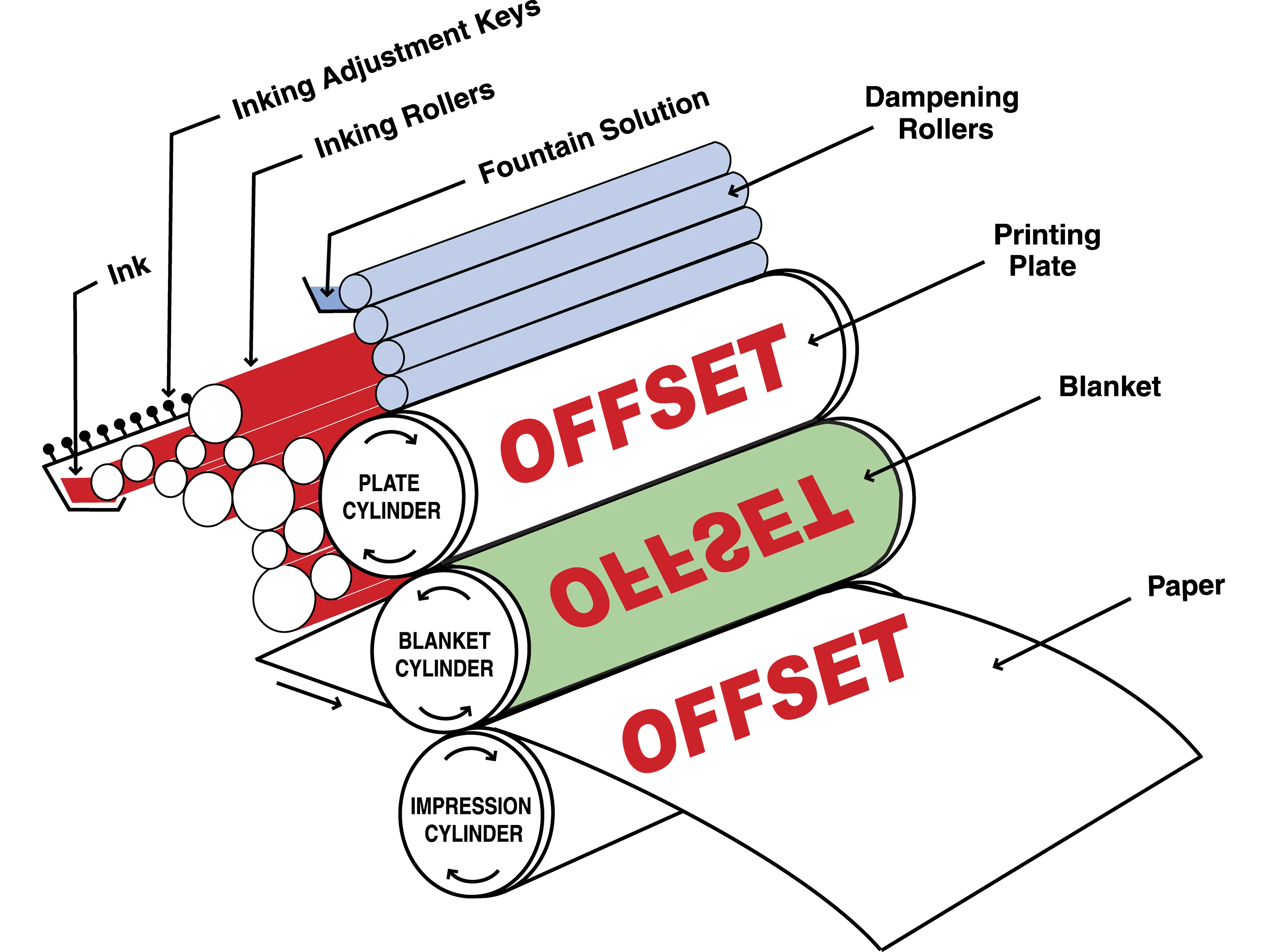
During a run, the dampening system lays a thin film of fountain solution onto the rotating plate cylinder just before it reaches the inking rollers. Surfactants drop the surface tension from water's native 72 mN/m down to roughly 35 to 45 mN/m, so the solution spreads into a sub-micron film across the non-image areas.
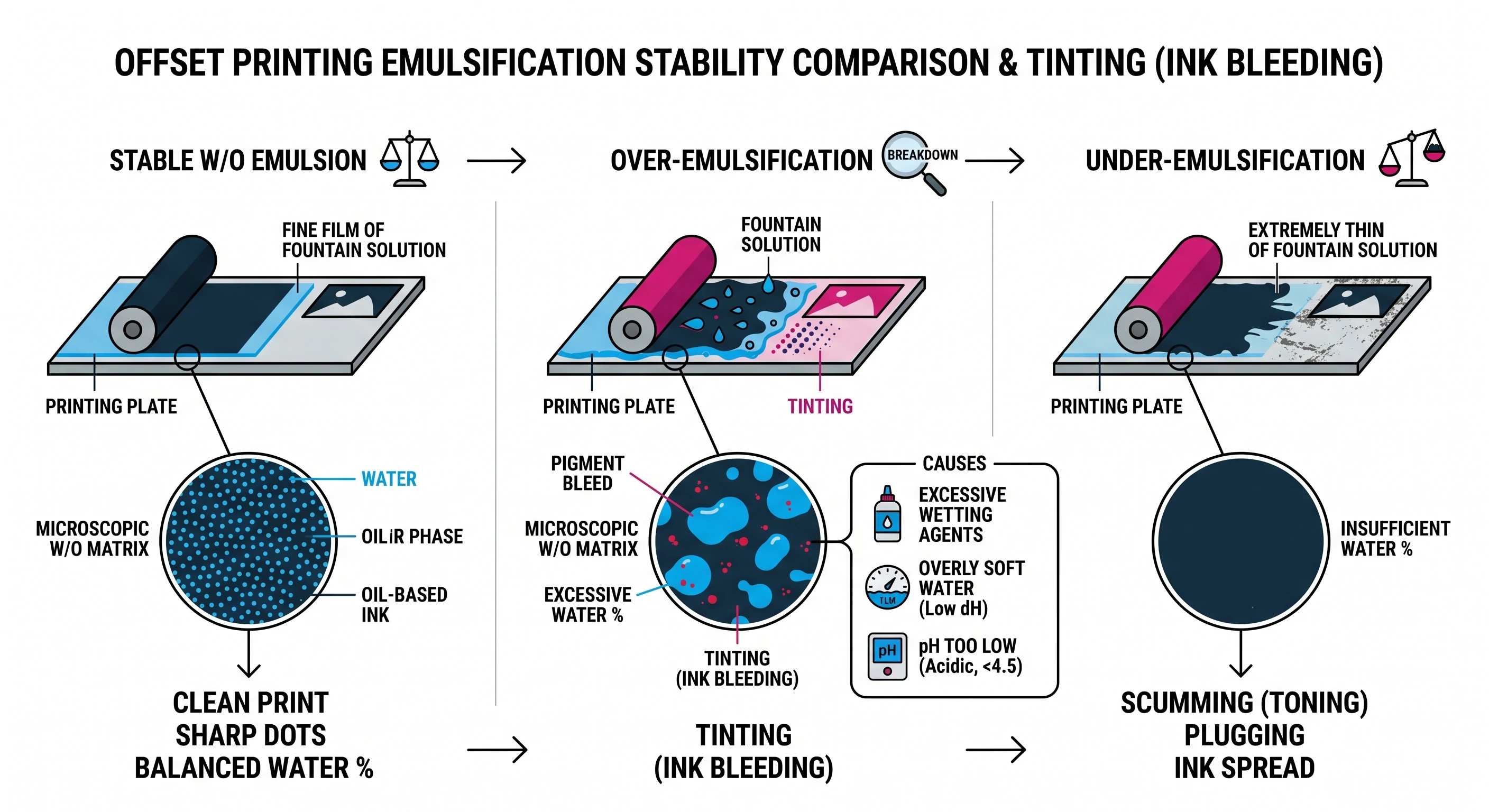
When the plate then hits the inking rollers, the oleophilic image areas grab the ink. The water-covered non-image areas repel it. Some fountain solution gets sheared into the ink during this high-speed contact. That is normal. Offset printing needs stable emulsification control: a water-in-oil (W/O) emulsion, with the ink absorbing between 15 and 25 percent water.
Over-dampening (too much emulsification): the ink's cohesion and viscosity collapse. Color fades. Drying slows. Tinting appears, where ink pigment bleeds back into the water pan.
Under-dampening: the water film ruptures. Ink sticks to non-image areas. That is scumming, sometimes called catch-up.
Six numbers define the health of your fountain solution. If you only check one, check conductivity. pH lies to you in a buffered system.
Parameter | Unit | Target range | What it tells you |
|---|---|---|---|
pH | — | 4.8 to 5.5 | Acidity; controls gum activity and plate desensitization |
Conductivity | µS/cm | 800 to 2,500 (fresh) | Concentrate dosage; rises as contamination builds |
Temperature | °C | 8 to 12 | Controls evaporation, viscosity, and microbial growth |
Water hardness | °dH | 8 to 12 | Prevents calcium soap formation and roller stripping |
Surface tension | mN/m | 35 to 45 | Determines wetting speed and film uniformity on the plate |
IPA concentration | % vol | 0 to 15 (type dependent) | VOC emissions and flammability risk |
Selecting fountain solution concentrates means looking at the whole pressroom, not just the label on the drum. Four things matter.
Press configuration. High-speed coldset web offset printing presses for newspapers and catalogs need low-foaming formulas that survive the mechanical beating without boiling over in the water pans. Sheet-fed commercial printing presses need formulations that promote fast setting and high gloss.
Plate technology. Standard pre-sensitized and CTP plates work with standard acidic etches. Process-free (processless) CTP plates develop right on the press: the fountain solution softens the non-image coating, and ink tack peels it off. These plates need a fountain solution that penetrates the coating quickly without causing premature plate blinding.
Ink chemistry. Conventional oil-based inks pair well with moderately acidic solutions at pH 4.8 to 5.2. UV Offset Ink and LED UV inks are different. Their resin backbones are sensitive to water pickup. Too much water slows photopolymerization and weakens the cured film. UV-specific fountain solutions restrict water emulsification to tighter limits.
Source water quality. Tap water with calcium and magnesium above 12 °dH reacts with the fatty acids in offset printing inks to form insoluble calcium soaps. These strip ink from the ink rollers and glaze the blankets — a condition known as roller stripping. Most shops run reverse osmosis (RO) to strip minerals, then blend back re-hardening salts to hit a stable 8 to 12 °dH.
Manual mixing by volume invites error. Chemical evaporation, operator fatigue, guesswork. Modern presses run automated dosing and monitoring.
Integrated refrigeration and circulation units like the Heidelberg CombiStar Pro mix concentrate at a precise ratio, usually 3 to 5 percent by volume. The solution circulates in a closed loop at a chilled 8 to 12 °C to control evaporation and hold viscosity steady.
Fountain solution circulation system with chiller, conductivity probe, and auto-dosing unit
Two measurements matter. pH tells you the acidity, but in a buffered system it is not a reliable measure of concentration because the buffer chemically masks changes. Conductivity, measured in µS/cm, gives an accurate linear reading of how much concentrate is present. Operators establish a baseline conductivity with fresh solution. Over time, paper dust, ink solvents, and calcium carbonate leach into the loop and drive conductivity up. When it climbs 1,000 µS/cm above baseline, emulsification control breaks down and the solution is spent. Replace it. Typical cycle: every two weeks.
Fountain solution concentrates contain strong acids, biocides, and surfactants. Store them in the original sealed polyethylene drums at 5 to 35 °C.
Freezing causes phase separation of the synthetic surfactants. Once separated, they do not recombine. The drum is dead. High heat degrades the desensitizing gums and kills the biocide.
Unopened shelf life: 12 to 24 months. Operators handling concentrates need chemical-resistant gloves and safety goggles. The acidic ingredients irritate skin and eyes on contact.
ISO 12647-2: Recommends buffered, standardized fountain chemistries that hold consistent ink-water balance to limit TVI (tone value increase) fluctuations.
ISO 3664: Printed sheets are evaluated under D50 standard viewing conditions. If over-dampening leaves excess water in the sheet, the paper's surface gloss and spectral response shift, so the proof no longer reflects what the press actually delivers.
REACH and RoHS: Modern solutions must exclude restricted nonylphenol ethoxylate (NPEO) surfactants and heavy metal catalysts.
Swiss Ordinance SR 817.023.21: For food packaging printing, fountain solutions must contain no low-molecular-weight volatile solvents or migratable toxic compounds. Any residual chemicals must not migrate through the substrate above the 10 ppb limit.
The biggest environmental problem with fountain solutions has always been isopropyl alcohol. IPA has a low flash point. At 12 percent concentration, the solution becomes flammable at 42 °C. Pressroom fires are a real risk.
IPA also pumps volatile organic compounds into the air. Operators breathe it. It contributes to photochemical smog outside the building.
Alcohol-free dampening solutions replace IPA with biodegradable glycols and synthetic surfactants. Because IPA is the dominant VOC contributor in the dampening system, cutting it removes nearly all of that load, and the fire hazard goes with it. Air quality improves. The fire hazard goes away. Formulators are also moving toward vegetable-derived organic acids like citric and malic acid, plus biodegradable synthetic polymers, to cut the chemical oxygen demand (COD) of pressroom wastewater — an important consideration for food packaging printing where low-migration chemistry is mandatory.
Problem | Likely cause | Solution |
|---|---|---|
Scumming (catch-up) | pH above 5.5; dampening feed too low; gum depleted | Increase concentrate dosage to bring pH to 4.8 to 5.2; increase dampening roller feed |
Tinting (ink bleeding) | Over-emulsification from excess wetting agents, water too soft, or pH too low | Replace contaminated solution; adjust hardness to 8 to 12 °dH; reduce wetting agent dosage |
Plate wear / blinding | pH below 4.5; acid abrading the plate image area | Increase buffer capacity; check concentration with conductivity meter; replace plate if worn |
Microbial slime | Biocide exhausted; stagnant solution in pans and lines; poor hygiene | Flush entire circulation loop with system cleaner; replace solution; add shock biocide dose |
Excessive foaming | Pump speed too high; surfactant overdose; wash-up water contamination | Check circulation pump; add silicone-free defoamer; verify dilution |
Roller stripping (calcification) | Water hardness above 12 °dH; calcium from paper coating leaching into ink train | Install RO system; treat water to 8 to 12 °dH; clean ink rollers with calcium remover |
Standard offset uses wet fountain solution to protect non-image areas. The alternative is waterless offset, which removes the dampening system entirely.
Standard wet offset. Flexible, lower plate costs, works with standard inks. The tradeoff: it needs a skilled operator managing the ink-water balance throughout the run.
Waterless offset. Uses plates coated with ink-repellent silicone rubber. No water means no paper stretching, no over-emulsification, less make-ready waste.
The catch. Waterless needs specialized high-viscosity inks that are sensitive to temperature. Without dampening fluid to cool the press through evaporation, waterless presses run actively chilled hollow rollers to keep ink temperature down. Heat makes the ink lose cohesion and stick to the silicone. That defect is called toning.
Modern presses monitor pH, temperature, and conductivity continuously. Instead of the operator checking manually every few hours, the system injects micro-doses of water, concentrate, or re-hardening salts to hold parameters inside the operating window. Less drift. Less waste.
Petroleum-derived glycols are being replaced by vegetable-derived surfactants, organic citric and malic acids, and natural biopolymers. Wetting performance on coldset web offset presses holds up to the same standard as IPA-based chemistry. The spent solution biodegrades. Carbon footprint drops.
As shops switch to process-free CTP plates, fountain solutions are being formulated to drive on-press development. Quick-penetrating surfactants swell the unexposed non-image polymer layer within the first ten to twenty impressions. The coating lifts off the aluminum base and transfers onto the waste sheets. No separate plate processor needed.
Water makes up 95 to 99 percent of the working solution. The rest is a chemical concentrate containing phosphoric or citric acid buffers for pH control, natural or synthetic gums to protect the plate, wetting agents to lower surface tension, biocides, and corrosion inhibitors.
Isopropyl alcohol is a fast wetting agent. It drops the surface tension of water quickly, letting it spread into a thin, uniform film across the plate. It also increases water viscosity for smooth roller transfer and evaporates fast to speed ink drying. The downsides: it is flammable and produces VOCs.
Alcohol-free fountain solution replaces IPA with synthetic surfactants like glycol ethers or polyether-modified silicones. Same low surface tension. Same wetting speed. No flammable emissions. No VOCs.
Hard water carries calcium and magnesium ions. These react with the fatty acids in ink to form insoluble calcium soaps, which strip ink from rollers, glaze blankets, and cause scumming. Water that is too soft triggers excessive foaming and over-emulsification. The sweet spot is 8 to 12 °dH.
The working range is pH 4.8 to 5.5. Below 4.5, the acid attacks the plate coating, corrodes rollers, and slows ink drying. Above 5.5, the desensitizing gum stops working, ink spreads into non-image areas, and the plate scums.
ISO 12647-2:2013, Graphic technology — Process control for the production of half-tone colour separations, proof and production prints — Part 2: Offset lithographic processes.
Bassemir, R., & Fuerst, A. (1995). The Physical Chemistry of Lithographic Dampening Solutions, Journal of Imaging Science and Technology.
ISO 7888:1985, Water quality — Determination of electrical conductivity.
Kipphan, H. (2001). Handbook of Print Media: Technologies and Production Methods, Springer-Verlag.
Schwegmann, B. (2018). Fountain Water in Offset Printing: Standard Parameters and Chemical Buffer Mechanics, Schwegmann Technical Brochure.
RBP Chemical Technology, Facts About Fountain Concentrates and Press Water Quality Control, RBP Technical Bulletin.
Fogra Forschungsgesellschaft Druck e.V., Dampening Solution Control: pH, Conductivity and Hardness Optimization, Fogra Certifications.
Heidelberg AG, Alcohol-Free and Alcohol-Reduced Offset Printing: Machine Configuration and Process Control, Heidelberg Eco Publications.
Swiss Federal Food Safety and Veterinary Office (FSVO), Ordinance on Materials and Articles in Contact with Food (SR 817.023.21, Annex 10).
European Printing Ink Association (EuPIA), Guidelines on Low-Migration and Non-Contact Pressroom Consumables.
Senefelder, A. (1818). A Complete Course of Lithography, Munich.
Printbar is a pressroom chemicals and printing consumables supplier. We manufacture fountain solutions for sheet-fed, web, and UV offset printing presses. As a china fountain solution supplier, our chemistry is backed by the same reference data on this page Alcohol-free. The chemistry is backed by the same reference data on this page, because if we cannot explain how it works, we should not be selling it.


 English
 Español
 فارسی
فارسی العربية
 Français
 Italiano
 Deutsch
 Português
 한국어
한국어 日本語
日本語 Türkçe
 Українська
 Русский
 Việt Nam
 ภาษาไทย
 Polski
 Nederlands
 Hindi
Hindi Urdu
Urdu Indonesian