Views: 22 Author: Printbar Publish Time: 06-17-2026 Origin: Site


This paper was completed with the assistance of Gemini AI. Reading time: ~20 min.
UV offset ink is a thick paste made from photopolymerizable resins, monomers, and photoinitiators. Under ultraviolet light it cures into a solid film in under a second. Unlike conventional offset ink, it contains no volatile organic solvents. That lets it print on plastic, foil, and metal, not just paper.
It is used in high-speed commercial packaging, publishing, and labeling. Wide color gamut, high gloss, and you can cut, fold, or laminate the sheet as soon as it hits the delivery pile. Stricter food safety and environmental regulations pushed ink makers toward low-migration and LED-UV formulations over the past decade.
Table of Contents
The name "UV offset ink" describes what it is: ultraviolet-curable polymer chemistry running through an offset lithographic press. In Chinese it is UV胶印油墨 (UV jiāoyìn yóumò). "胶印" refers to the rubber blanket cylinder that transfers the ink film. "油墨" means printing ink.
Technical literature calls it "UV-curable offset ink," "UV lithographic ink," or "UV-curing paste ink." It is chemically different from UV-curable inks made for flexo, screen, or inkjet. Those are low-viscosity liquids. UV offset ink is a paste: high body, high tack, built for roller trains.

The science behind UV photopolymerization traces back to polymer patents filed in the 1940s and 1950s. Ink companies began selling UV-curable inks for graphic arts in the late 1960s.
1970s: UV offset ink got its first real commercial footing in metal decorating and packaging. The problem it solved was simple. Traditional metal decorating ran sheets through long, gas-fired thermal ovens to dry solvent-based inks. UV ink cured in a fraction of a second and collapsed the production line footprint.
1990s: Cationic UV curing systems arrived alongside the established free-radical acrylate systems. Cationic inks, built on cycloaliphatic epoxides, shrank less during cure and bonded better to metallic foils and cans.
2000s: Major press builders like Komori and Heidelberg rolled out high-sensitivity, low-energy UV systems (H-UV and LE-UV). A single low-power, ozone-free mercury lamp could cure at speed. Around the same time, solid-state LED UV curing arrays entered the market.
2010s to present: Ink makers developed low-migration (LM) UV offset inks to stop unreacted photoinitiators from leaching into packaged food. European food safety law drove this shift.
Era | Milestone | Technical impact |
|---|---|---|
1940s to 1950s | Early UV patents | Foundation of photopolymerization |
Late 1960s | First commercial inks | Instant curing on non-porous paper |
1970s | Commercial adoption | Expansion into packaging, plastics, and metal |
1990s | Cationic UV systems | Low shrinkage, metal packaging |
2000s | H-UV / LE-UV & LED UV | Lower energy, mercury-free lamp arrays |
2010s to present | Low-migration UV | Food-grade packaging compliance |
Conventional sheet-fed offset ink uses mineral or vegetable drying oils that take hours to set through absorption and oxidation. UV offset ink works differently. It is a 100 percent solids system. Every liquid component in the formula reacts chemically and becomes part of the final solid polymer film. Nothing evaporates.
Organic and inorganic pigments are picked for purity, color strength, and lightfastness. Pigments absorb or scatter UV radiation, so their loading level, chemistry, and transparency matter a lot. Too much pigment blocks the light and kills the cure. Low-migration inks also require pigments with extremely low levels of primary aromatic amines (PAAs).
These form the main film. They determine gloss, elasticity, chemical resistance, and rub resistance. Common materials: epoxy acrylates, polyester acrylates, polyurethane acrylates. Hyperbranched polyester acrylic resins are often chosen to get high crosslinking density without driving viscosity through the roof.
Low-viscosity, multi-functional acrylates like tripropylene glycol diacrylate (TPGDA) or trimethylolpropane triacrylate (TMPTA). They act as the solvent phase during manufacturing but participate in the crosslinking reaction during curing. Nothing evaporates into the air.
These compounds cleave or abstract hydrogen when hit with specific UV wavelengths, generating the free radicals or cations that start polymerization. Benzophenone, thioxanthones, and acylphosphine oxides are common. Acylphosphine oxides are often picked for LED UV systems because they absorb in the 385 to 395 nm range.
In-can polymerization inhibitors like monomethyl ether of hydroquinone (MEHQ) prevent the ink from gelling in storage. Defoamers, slip agents like polyethylene or PTFE waxes for rub resistance, and rheology modifiers round out the formula.
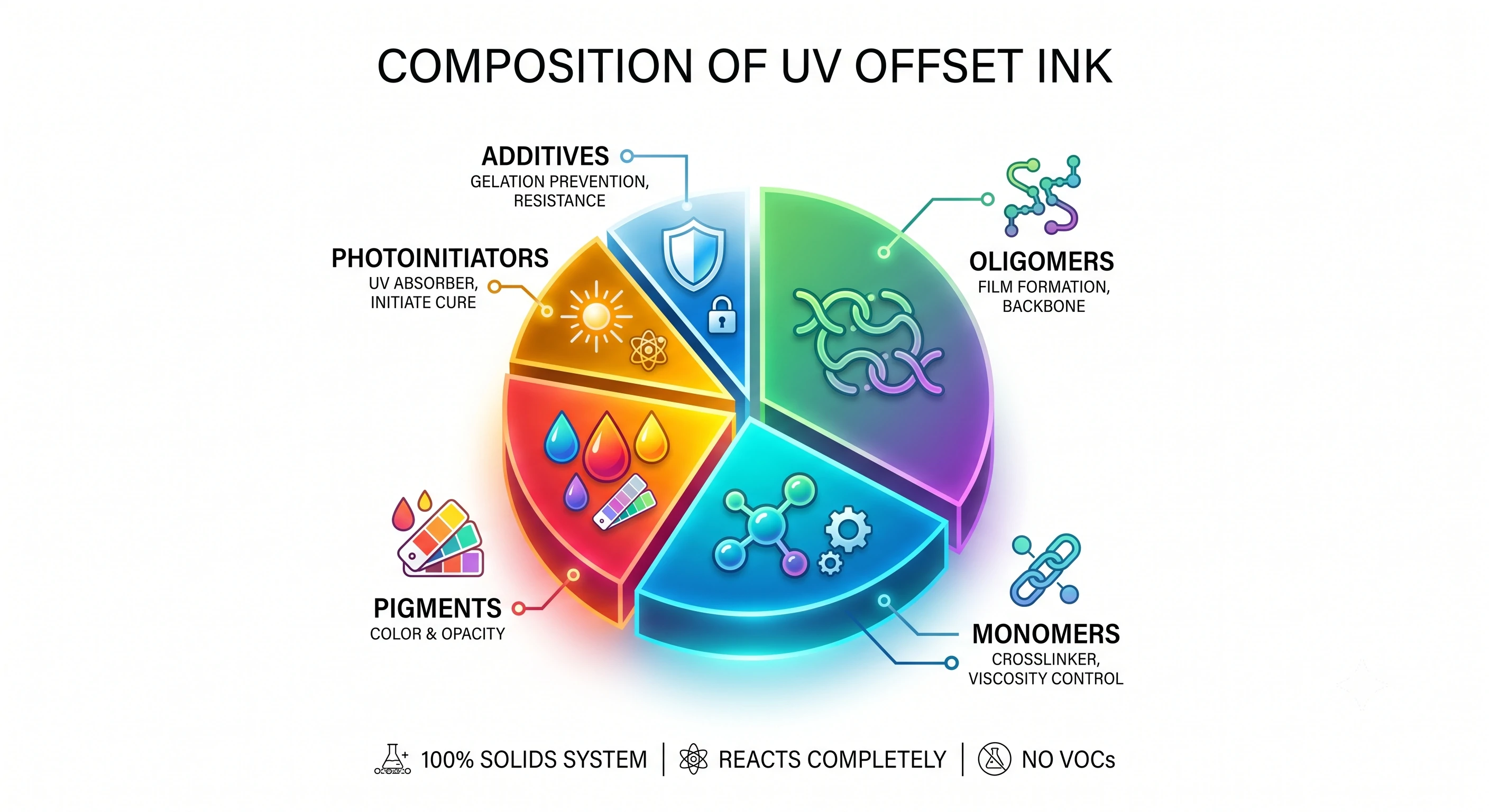
Component | Typical % | Function | Common materials |
|---|---|---|---|
Pigments | 10% to 25% | Color and opacity | Organic azo, phthalocyanine |
Oligomers | 25% to 45% | Resin backbone, film-former | Epoxy acrylates, polyester acrylates |
Monomers | 25% to 40% | Viscosity reducer, crosslinker | Tripropylene glycol diacrylate (TPGDA) |
Photoinitiators | 3% to 10% | Absorbs UV photons, initiates cure | Benzophenone, polymeric photoinitiators |
Additives | 1% to 5% | Prevents gelation, scuff resistance | MEHQ inhibitor, PE/PTFE wax |
UV offset inks are grouped by polymerization chemistry, lamp requirements, and safety parameters.
The most common type, based on acrylate chemistry. They cure fast but suffer from oxygen inhibition at the surface. Standard medium-pressure mercury arc lamps drive the cure. High gloss, good mechanical resistance.
Built on epoxy and vinyl ether monomers. They cure through ring-opening polymerization triggered by photo-generated acids. No oxygen inhibition. Very low shrinkage. Excellent adhesion to non-porous metals. These are the standard for three-piece metal decorating and tube printing. The tradeoff: they cure slower than free-radical inks and are sensitive to pressroom humidity.
Formulated to match the narrow spectral output of UV LED lamps, usually monochromatic at 385 nm or 395 nm. They use photoinitiators tuned to that narrow window. LED lamps run cold, so these inks work well on thin, heat-sensitive plastic films.
Designed to eliminate chemical migration in food, beverage, and pharmaceutical packaging. Small volatile monomers and photoinitiators are completely excluded. The formula uses high-molecular-weight oligomers and polymeric photoinitiators like Omnipol BP or Omnipol TX, all exceeding 1000 Daltons. That molecular weight keeps them from migrating through paperboard or plastic.
Type | UV source | Key characteristics | Typical application |
|---|---|---|---|
Free-Radical | Mercury arc lamp | High gloss, instant cure, oxygen inhibited | General folding cartons |
Cationic | Mercury arc lamp | Slower, low shrinkage, excellent metal adhesion | Beverage cans, metal aerosols |
LED UV | LED array (385/395 nm) | Low heat, mercury-free, energy-efficient | Heat-sensitive plastics, labels |
H-UV / LE-UV | High-sensitivity UV lamp | Single lamp, wide substrate compatibility | Sheet-fed luxury publishing |
Low-Migration | Mercury or LED | Monomers over 1000 Da, polymeric photoinitiators | Food packaging, pharmaceuticals |
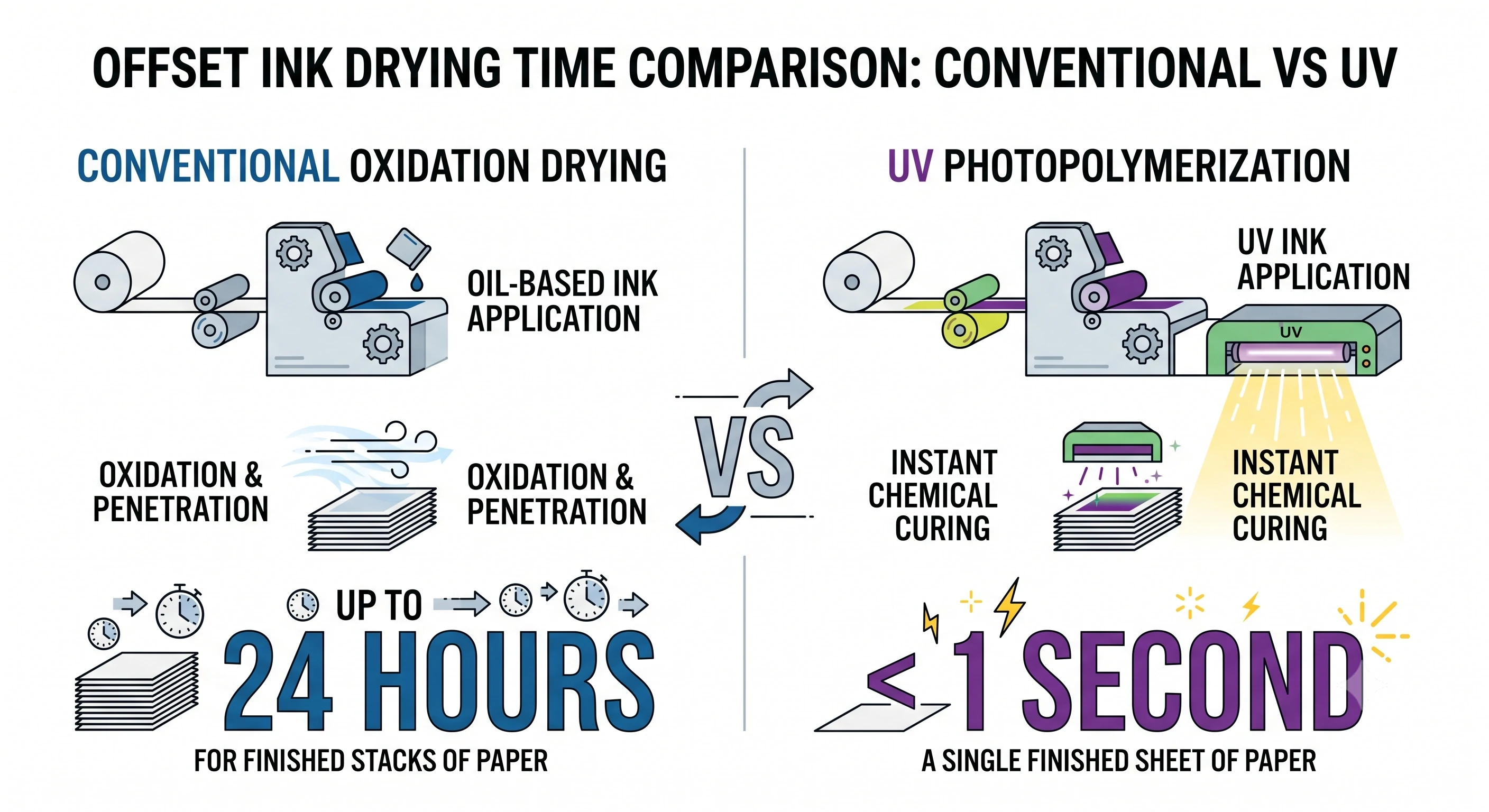
UV offset ink does not "dry" in the conventional sense. It undergoes a phase change driven by photopolymerization instead of the slow solvent evaporation or oxidative crosslinking of traditional inks.
When the ink film passes under a UV lamp, photoinitiators absorb UV photons and jump to an excited state. They undergo homolytic cleavage (Type I photoinitiators) or hydrogen abstraction from a co-initiator (Type II) to generate active free radicals. Those radicals attack the double bonds of acrylate monomers and oligomers, creating active monomer radicals that propagate through the ink layer.
The steady-state polymerization rate follows this relationship:
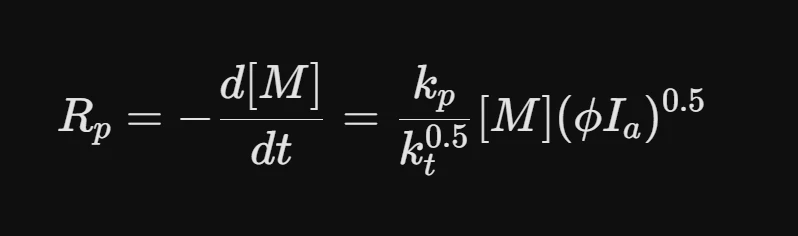
Where Rₚ is the polymerization rate, [M] is monomer concentration, kₚ and kₜ are propagation and termination rate constants, φ is the quantum yield of initiating radicals, and Iₐ is the intensity of absorbed light. In a fraction of a second, the reactive species form a highly crosslinked, three-dimensional polymer network.
Free-radical UV curing has one persistent chemical problem: oxygen. Atmospheric O₂ acts as a radical scavenger. It reacts with initiating or propagating radicals to form inactive peroxy radicals, which stalls the cure at the ink surface. Ink chemists counter this by adding amine synergists that consume oxygen. Some printers purge the curing zone with nitrogen, a nitrogen blanket. Both approaches work. Neither is free.
One operational upside of this instant-cure chemistry: UV offset ink can sit on the roller train indefinitely without drying or skinning. Press stops do not mean wash-ups.
UV offset inks run on high-speed presses and print on non-porous substrates. Their physical and chemical properties are measured against specific standards.
UV offset inks are non-Newtonian, thixotropic fluids. Under the high shear rates of a press roller train, up to 10,000 s⁻⊃1;, viscosity drops to allow smooth transfer. It recovers instantly on the plate to prevent dot gain and bleeding. Viscosity is measured with falling rod viscometers per ISO 12644 or rotational viscometers, giving a dynamic range of 15 to 40 Pa·s.
Tack measures internal cohesion: the force needed to split the ink film between rotating rollers or between blanket and substrate. Measured under ISO 12634 using a TackOscope or Inkometer at a stabilized 30°C or 32°C. Too much tack pulls fibers from the paper (picking). Too little lets the ink emulsify, causing scumming or tinting.
Property | Unit | Standard method | Typical range | What it tells you |
|---|---|---|---|---|
Viscosity | Pa·s | ISO 12644 | 15 to 40 | Press transfer and anti-misting |
Tack | Tack Units | ISO 12634 | 6 to 12 | Splitting force; prevents picking |
Fineness | µm | ISO 1524 | ≤ 10 | Plate abrasion risk |
Reactivity | mJ/cm² | Cure test | 50 to 150 | Maximum press speed |
Adhesion | — | ISO 2409 | Class 0 to 1 | Film stability on plastics and foils |
Gloss | GU (60°) | ISO 2813 | 75 to 95 | Visual appearance |
Rub resistance | cycles | ASTM D5264 | > 100 | Survives transport handling |
Migration | ppb | SIO Annex 10 | < 10 | Food packaging compliance |
Aspect | UV Offset Ink | Conventional Offset Ink |
|---|---|---|
Drying mechanism | Photopolymerization (under 1 s) | Oxidation and absorption (hours) |
VOC content | Zero to near-zero | 20% to 40% (mineral/vegetable oils) |
Substrate range | Paper, plastic, metal, metallized board | Porous paper and board |
In-can/press stability | Stable; does not dry on rollers | Tends to skin; needs anti-skinning agents |
Post-press turnaround | Immediate finishing and shipping | Delayed by slow oxidative drying |
Viscosity (Pa·s) | 15 to 40 | 40 to 100 |
Relative cost | 2 to 4 times higher per kg | Baseline |
Recyclability / De-inking | More difficult, cured crosslinked film | Well established, standard repulping |
Environmental concerns | Mercury and photoinitiator migration | VOC emissions and MOSH/MOAH |
Because UV offset inks cure through light rather than solvent evaporation or absorption, they work on surfaces that conventional ink cannot touch.
Plastics and films. PVC, PET, polypropylene, and polyethylene sheets. Used for loyalty cards, clear folding boxes, industrial labels. Before printing, the plastic surface needs corona or plasma treatment to push surface tension above 38 dyne/cm. Without it, the ink will not bond.
Metalized board and metal. Luxury cosmetics, high-end spirits, aerosol cans. Cationic inks or flexible free-radical formulations handle the post-cure bending, stamping, and embossing without cracking.
Synthetic paper. Yupo, Teslin, and other non-absorbent synthetic substrates. Outdoor maps, tags, industrial safety labels.
Coated and uncoated paper. In high-end commercial work, UV curing stops ink from sinking into paper fibers, a problem called burnout. Dots stay sharp. Colors hold their saturation. Black solids stay deep.
UV offset ink needs curing systems installed at the end of the press or between printing units.
These are the traditional workhorse. An electrical arc discharged through vaporized mercury emits a broad UV spectrum, roughly 200 nm to 450 nm. Doping with iron or gallium shifts output toward longer wavelengths for deeper ink penetration. The downsides are real: high energy consumption, extreme heat requiring water-cooled chill rollers or air cooling, ozone generation that must be vented, and a short bulb life around 1,500 hours.
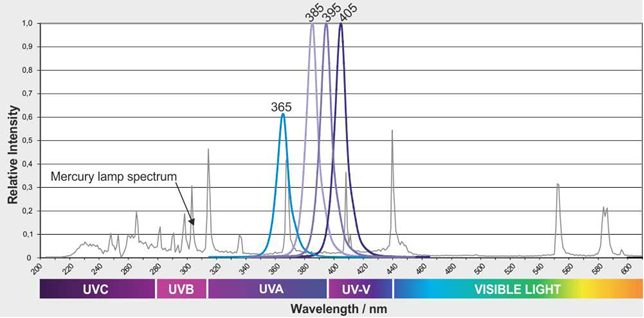
LED UV arrays use solid-state diodes to emit narrow-band monochromatic UV, usually at 365 nm, 385 nm, 395 nm, or 405 nm. They consume up to 70 percent less energy than mercury lamps. Zero ozone. Operating life over 20,000 hours. They run cold, which means thin plastic films do not warp during high-speed printing.
UV LED curing demonstration (0:00 to 1:00)
Two main layouts:
Interdeck curing mounts UV lamps between individual color stations. This matters when printing on non-porous plastics. Curing each color before the next one hits prevents the wet ink from bleeding into the next unit.
End-of-press curing uses high-intensity lamps to cure the full multi-color ink film before sheets enter the delivery pile. This stops blocking, sheets sticking together under stack weight.
Under ISO 12647-2, prints made with UV offset inks must hit targeted solid colorimetric CIELAB coordinates and standard tone value increase (TVI) curves. ISO 2846-1 specifies the exact color and transparency coordinates for CMYK process inks, measured under D50 standard illuminant with a 2° observer on Phönix Imperial APCO II/II reference paper.
This is the reference standard for food-packaging inks. Annex 10 lists fully evaluated substances in Part A, each with specific migration limits. Non-listed substances (Part B) must not migrate into food above the 10 ppb (0.01 mg/kg) detection limit. Carcinogens, mutagens, and reproductive toxins are banned outright.
These EU regulations govern food contact materials. They enforce an overall migration limit of 60 ppm (10 mg/dm²) from the final packaging into food.
Limits the combined total of lead, cadmium, mercury, and hexavalent chromium in packaging inks to under 100 ppm.
UV offset inks contain no volatile organic solvents. No VOC emissions from the pressroom. No anti-set-off spray powder needed, so the working environment stays cleaner.
UV ink curing chemical mechanism — food packaging compliance and minimizing uncured monomer migration
In 2005, isopropyl thioxanthone (ITX), a photoinitiator used in outer carton ink, migrated into Nestlé baby milk in Italy. The printed outer side of the packaging, wound on a reel, pressed against the unprinted food-contact inner side. ITX transferred through and contaminated the liquid milk. That incident reshaped the industry. It drove adoption of strict low-migration ink guidelines, including the Nestlé Guidance Note and the EuPIA Exclusion Policy. Ink makers reformulated around the problem: larger molecules that cannot migrate, photoinitiators too heavy to diffuse through paperboard or plastic.
Ink component migration in food packaging — how low-migration products are formulated for food safety
Uncured acrylate monomers and oligomers in UV inks are skin sensitizers. They can cause irritation, redness, chemical burns, and blistering.
Skin contact: wash immediately with soap and plenty of water. Never use petroleum solvents or ink thinners to clean UV ink off skin. They accelerate penetration through the skin.
Eye exposure: flush with cool water for at least 15 minutes. Get medical attention with the Safety Data Sheet (SDS) in hand.
PPE: nitrile or butyl protective gloves and safety goggles when handling uncured inks or UV wash solvents. Not optional.
Problem | Likely cause | Solution |
|---|---|---|
Poor adhesion (undercure) | Low UV intensity; aged lamps; excessive ink film thickness; wrong photoinitiator wavelength match | Measure UV output; replace lamps; reduce ink film; adjust press speed; verify wavelength match |
Ink misting on rollers | Viscosity too low; ink too soft for press speed; press temperature too high | Check roller cooling water; adjust viscosity; reduce press speed |
Ink skinning on rollers | Stray UV light hitting press rollers; low in-can stabilizer levels | Install lamp shields; check press guarding; check inhibitor levels |
Poor rub resistance | Incomplete surface cure from oxygen inhibition; insufficient wax additives | Increase UV lamp power; purge with nitrogen; add PE/PTFE waxes |
Strong chemical odor | Residual unreacted monomers or photoinitiators in cured film | Increase curing dose; slow press; switch to low-odor polymeric photoinitiators |
Blocking in delivery stack | Residual heat in pile; incomplete curing; excessive stacking weight | Adjust cooling rollers; reduce pile height; optimize UV lamp output |
Pinholes / fisheyes | Substrate surface tension below 38 dyne/cm | Increase corona or plasma treatment; add surfactant wetting agent |
Water-ink balance failure | UV ink interacts differently with fountain solution; pH or conductivity off | Adjust fountain solution additive to pH 4.8 to 5.2; monitor conductivity |
UV offset ink is a thick, paste-like consumable made from photopolymerizable acrylic resins, monomers, and photoinitiators. Unlike conventional solvent-based inks, it cures into a solid polymer film the moment ultraviolet light hits it. Zero VOCs.
It does not dry. It cures. When ultraviolet light hits the ink, photoinitiators trigger a chain reaction that cross-links monomers and oligomers into a solid plastic film in under a second. Conventional ink takes hours to oxidize and absorb into the sheet.
Conventional offset ink uses organic solvents or vegetable oils and sets slowly over hours. UV offset ink is solvent-free, 100 percent solids, and cures instantly under UV light. It prints on non-porous plastics, foils, and metal. No VOC emissions.
The raw materials are more expensive. Specialty acrylic oligomers, reactive monomer diluents, and advanced photoinitiators cost more than mineral or vegetable oils. The manufacturing process is more complex. You pay 2 to 4 times more per kilo. Whether the total cost of ownership is higher depends on your throughput, spoilage rate, and turnaround requirements.
Standard UV ink carries migration risk. Low-migration UV offset inks, formulated with large polymeric photoinitiators and high-molecular-weight oligomers, are safe for indirect food contact. They comply with Swiss Ordinance SR 817.023.21 Annex 10 limits.
LED UV offset printing swaps traditional mercury vapor lamps for energy-efficient LED arrays. It operates at specific monochromatic wavelengths, produces no ozone, and runs cold. Heat-sensitive plastic films do not warp. Lamp life exceeds 20,000 hours versus about 1,500 for mercury.
No. Standard UV offset inks contain zero or near-zero volatile organic compounds. No evaporative mineral solvents. No water-miscible alcohols. Every bit of wet ink film on the plate reacts chemically and becomes part of the cured solid layer.
ISO 2846-1:2017, Graphic technology — Colour and transparency of printing ink sets for four-colour printing — Part 1: Sheet-fed and heat-set web offset lithographic printing.
ISO 12647-2:2013, Graphic technology — Process control for the production of half-tone colour separations, proof and production prints — Part 2: Offset lithographic processes.
ISO 12634:2017, Graphic technology — Determination of tack of paste inks and vehicles by a rotary tackmeter.
ISO 12644:1996, Graphic technology — Determination of rheological properties of paste inks and vehicles by the falling rod viscometer.
Swiss Federal Food Safety and Veterinary Office (FSVO), Ordinance of the FDHA - SR 817.023.21, on materials and articles intended to come into contact with food (Chapter 12 & Annex 10).
European Printing Ink Association (EuPIA), Good Manufacturing Practice (GMP) for Printing Inks Formulated for Food Contact Materials.
Nestlé, Nestlé Guidance Note on Packaging Inks (Exclusion Policy and Minimisation Lists).
German Federal Institute for Risk Assessment (BfR), Recommendation IX: Colorants for Plastics and Consumer Goods (PAA Migration limits).
Kipphan, H. (2001). Handbook of Print Media: Technologies and Production Methods, Springer-Verlag.
IARC Monographs, Volume 65, Printing Inks and Processes.
Bassemir, R. (1995). The Physical Chemistry of Radiation Curable Offset Inks, Journal of Imaging Science and Technology.
Toyo Ink Group, Technical Documentation: Formulation of Acrylate Monomers and Hyperbranched Polyester Acrylic Resins in UV Paste Inks.


 English
 Español
 فارسی
فارسی العربية
 Français
 Italiano
 Deutsch
 Português
 한국어
한국어 日本語
日本語 Türkçe
 Українська
 Русский
 Việt Nam
 ภาษาไทย
 Polski
 Nederlands
 Hindi
Hindi Urdu
Urdu Indonesian