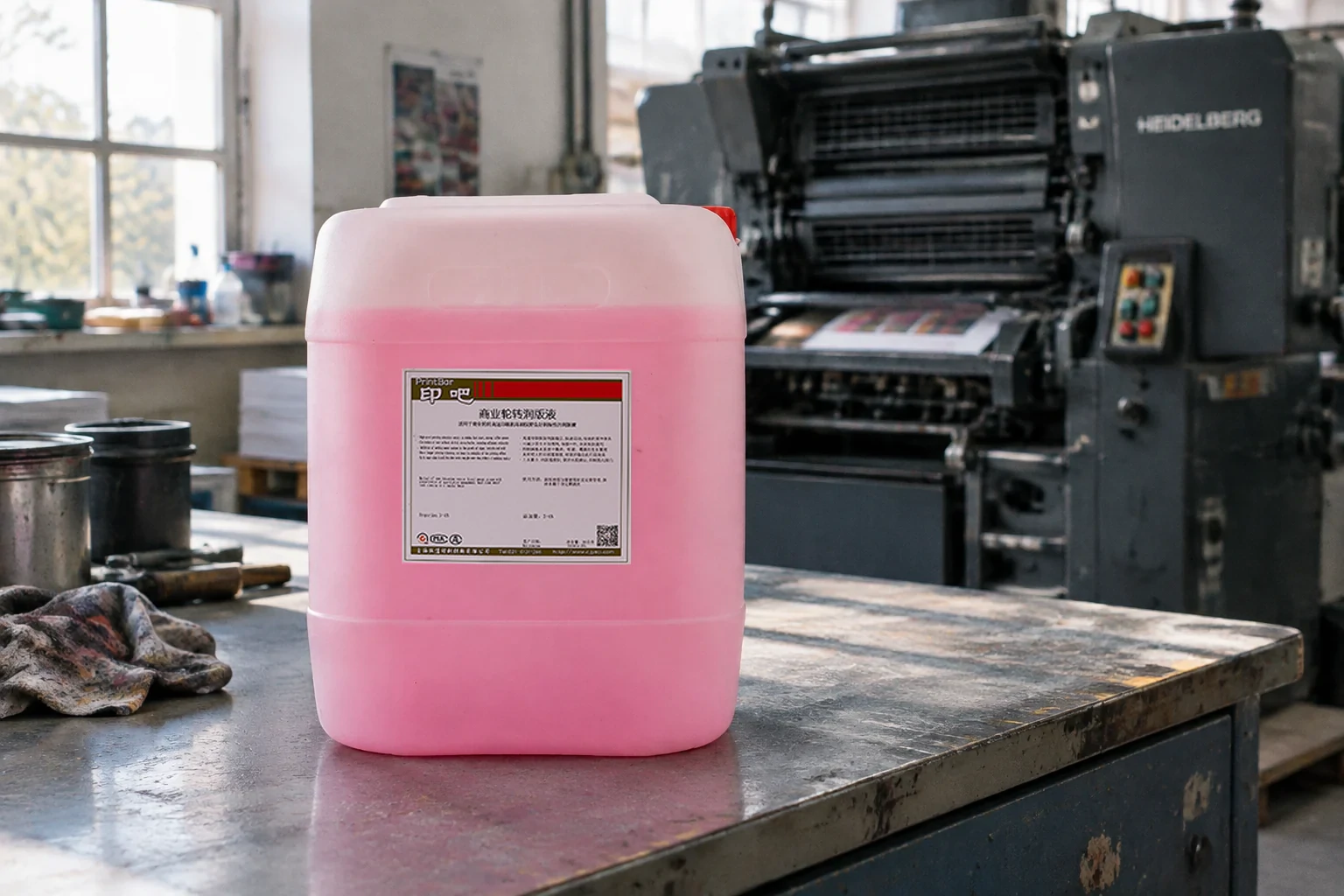
Six measured parameters hold the dampening system together, and a pen meter, a sample cup and ten minutes on the floor will tell you where each one stands.
Many small and medium print shops still underrate what fountain solution does. It keeps the non-image areas of the plate clean, helps cool the cylinder train and pairs with the ink to lay down a sharp, consistent dot. Because print quality depends on stable ink-water balance, knowing how the fountain solution behaves, and how to test it, is one of the faster routes to less makeready waste.
All six parameters below can be checked with equipment already in the shop. They are listed in the order most pressrooms should measure them, followed by the choice of formula and the six variables that govern dosage.
Six fountain solution parameters every press operator should track
1. pH value: the 4.8–5.3 window. Fountain solution pH cannot be left to drift in either direction. Run it too high, towards alkaline, and surface tension drops, the oleophilic image layer is attacked and the ink emulsifies heavily. Run it too low, towards acidic, and oxidative drying slows on the sheet while the aluminium grain of the plate corrodes, shortening plate life.
For conventional offset plates the working window is pH 4.8 to 5.3. Inside it, ink-water balance is easiest to hold and the print stays crisp. A pocket pH meter with ±0.1 accuracy is enough on the floor: rinse the probe with clean water, calibrate it against a neutral pH 7.0 buffer, pull a sample from the recirculation tank into a clean cup, let it settle until the reading is still, then record it.
2. Conductivity: a real-time gauge of concentration. Modern presses dose concentrate from a conductivity set point, so the target decides how much chemistry reaches the circulator and, from there, how the ink-water balance behaves. Different brands are formulated differently and their baseline conductivity varies widely; local water hardness and water temperature move the reading as well. Set the target for the brand you actually run and the water actually in the plant, not for the figure on a data sheet.
A handheld conductivity pen, rinsed and calibrated, is enough to check it on the floor. The number reflects the concentration of the fountain solution, so tracking it tells you whether the dosage is on the mark. Logged together, fountain solution pH and conductivity give a quick read on whether the mix is behaving or drifting.
3. Isopropyl alcohol concentration. Fountain solution mixed with isopropyl alcohol is known in the trade as alcohol dampening solution. IPA lowers the surface tension of water and raises viscosity, so the film carries smoothly through the roller train. Traditional alcohol systems ran around 15%, but IPA is expensive and regulated for VOC emissions, and most modern fountain solutions now include wetting agents that cut the requirement sharply.
Alcohol content can be checked with a hydrometer float. During dampening audits, Germany's FOGRA measures the solution with a precision density meter and reads the result against a density lookup table to establish the exact IPA percentage, a method press makers and consumable suppliers both recommend.
4. Surface tension and plate wetting. A fountain solution has to spread quickly across the non-image areas and stay there as an even film. The lower its surface tension, the better it wets and spreads across the plate grain.
The drop test is the shop-floor measure. Place a drop of mixed solution on a blank section of a printing plate and inspect it through a printer's loupe. A drop that beads up and refuses to spread means surface tension is too high. One that fans out quickly in every direction means plate wetting is where it should be.
5. Buffering capacity: why pH alone can mislead. Calling fountain solution a buffered solution means that diluting it, or adding a small amount of strong acid or alkali such as alkaline coating dust, barely shifts the pH. Manufacturers build buffers in for exactly that reason. The same buffer creates a blind spot: because pH is locked in place, the reading cannot tell you whether the concentration is weak or strong. Titration is the measure. Add a colour indicator to the solution and count how much titrant it takes to drive the colour change.
6. Dampening solution temperature. Temperature moves ink-water balance on its own, with the press settings unchanged. Warm fountain solution accelerates emulsification and pushes operators to run more water; cooler solution holds emulsification back. The pressroom warms the pan, so room temperature matters. In hot summer months some shops drop frozen blocks of mixed solution straight into the pan to bring it down and stop runaway emulsification. A pocket thermometer verifies the pan temperature.
Choosing the right formula and controlling dosage
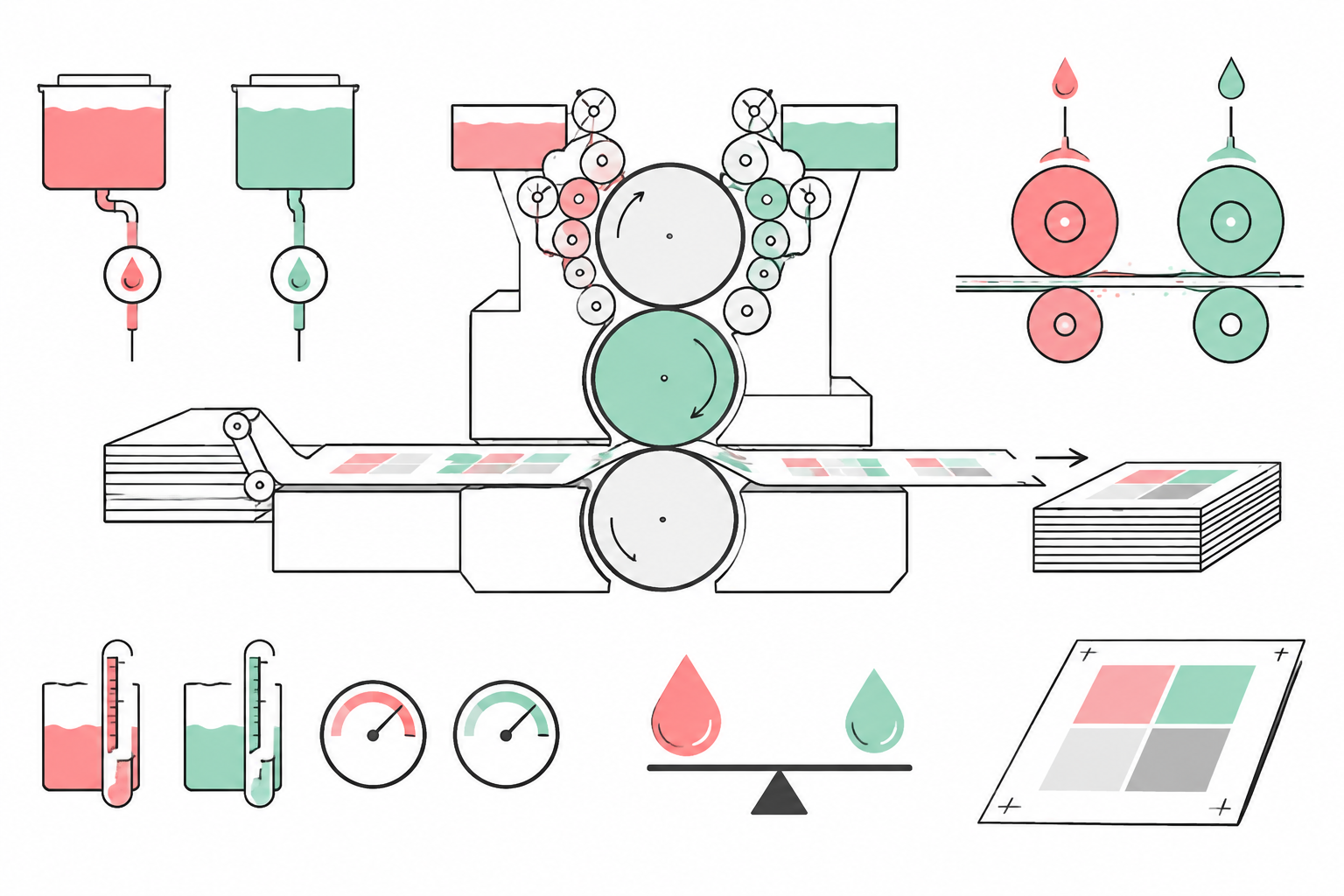
Because fountain solution affects almost everything downstream, matching the formula to the pressroom deserves a proper look. Products in the offset printing chemicals market divide two ways:
Two ways to classify offset fountain solution
Classification | Options on the market |
|---|---|
By chemical composition | Alcohol-based (IPA) fountain solution; conventional non-alcohol fountain solution; surfactant-based alcohol-replacement fountain solution |
By press application | High-speed coldset web for newspapers; high-speed heatset commercial web; sheetfed offset |
Choice should follow the press equipment, the run speeds and the production environment. Price per litre comes second, because the wrong formula costs more in makeready and waste than it saves at the drum.
Six variables that govern fountain solution dosage
The controlling rule is to run the least water that keeps the plate from scumming, then adjust around six variables. No two jobs sit at the same point.
How pressroom variables change fountain solution dosage and feed
Pressroom variable | How to adjust fountain solution dosage and feed |
|---|---|
1. Paper moisture and surface strength | High-moisture paper needs less water; dry, low-moisture stock needs more. On paper with low surface strength that sheds lint or picks, a slight increase in water volume flushes the debris away and prevents scumming. |
2. Ink emulsification properties | Inks that resist emulsification need a slightly higher fountain solution concentration to hold a stable ink-water balance. |
3. Plate type (CTP or PS) | CTP and conventional PS plates have different surface properties, and CTP needs a slightly thicker water film. The stronger the water affinity of the non-image area, the more solution it takes to wet it completely. |
4. Printed image coverage | Heavy solid coverage demands noticeably more fountain solution than light text forms or halftone tints. |
5. Press running speed | Demand climbs with speed, so step up the water feed rate as impressions per hour rise. |
6. Ambient shop temperature | The hotter the pressroom, the more fountain solution is needed to compensate for evaporation and heat. |
The settings do not stay put. Paper changes between jobs, the shop warms through the afternoon and a new brand resets the conductivity baseline, so the six numbers are worth re-checking at the start of a shift. Shops that test and adjust consistently spend less on chemistry, waste fewer sheets at makeready and get a more predictable sheet off the delivery.