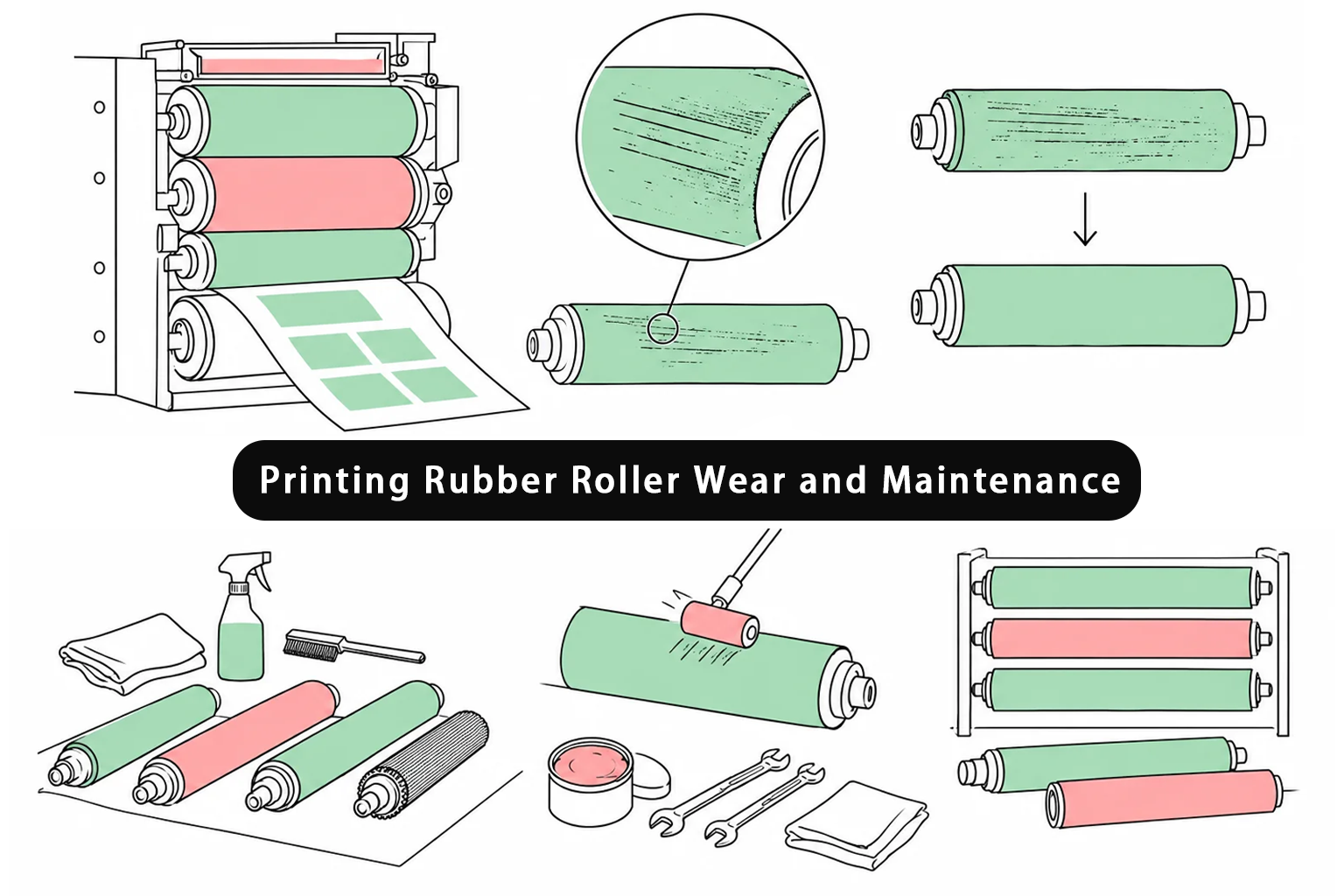
Fifteen everyday causes and ten habits decide how long a set of offset press rollers lasts, and most of them are cheaper to fix than to ignore.
Ask a pressroom manager where the consumables budget goes fastest and rubber rollers sit near the top of the list. Inking and dampening rollers do the heavy lifting on every impression. Dialled in, holding ink-water balance feels effortless. Neglected, over-tightened or cleaned with the wrong chemistry, the rubber hardens, glazes or cracks months ahead of schedule, and the shop is left with ghosting, ink stripping, unplanned downtime and a replacement bill that arrives all at once.
Most of those failures begin on the shop floor rather than at the rubber supplier. A bad batch of compound is rare. Fifteen everyday causes account for the bulk of premature wear, and checking any one of them costs less than replacing a set of printing press rollers.
Fifteen everyday causes behind premature roller wear
If the shop is burning through printing press rollers faster than the work justifies, audit the routine against this list before ordering replacements.
Uneven roller nip pressure. Set too tight, or left heavy on the gear side and light on the operator side, and the nip generates friction and heat that chew up the rubber surface.
Unlatched pan roller handles. Forgetting to lock both end handles on the water pan roller can tear the surface of the metering roller. One side left open, or only half seated, is enough to punish the metering roller and the dampening form roller together.
Sloppy plate mounting and tensioning. A conventional PS or CTP plate that is not seated flat against the cylinder, or whose gripper and tail-edge clamping bolts are not pulled evenly, buckles in the loose section and slaps the rollers on every revolution. Cranking the tension too tight does the other half of the damage: the plate edge warps or cracks and gouges the rollers, with the softer-durometer dampening form rollers showing it first.
Edge friction on long runs. On a marathon run the outer ends of a roller see different heat build-up and lubrication from the centre, and the shoulders wear faster than the middle.
Abrasive, low-grade paper stock. Cheap dusty paper sheds lint, coating filler and grit straight into the dampening and inking trains, where it acts like sandpaper on rubber rollers and copper oscillators.
Register marks scratched into plates. A razor blade, awl or scribe used to mark side guides on the plate leaves raised metal burrs that cut into form rollers as the press turns.
Hard tap water and calcium glazing. Untreated, mineral-heavy water without conditioning deposits scale into the roller pores. As roller glazing sets in, Shore A hardness climbs, friction spikes and the roller loses its affinity for ink and water, which costs print quality as well as the roller.
Skipping scheduled roller rotation. Running one set month after month without swapping it out for rest and off-press reconditioning can halve the working life of the set.
Delayed wash-ups and dried ink. Stretch the interval between wash-ups and ink skins over and cures on the metering roller and the ink train, leaving a rough crust that grinds the rollers it runs against.
Aggressive speciality inks and substrates. Metallic board, pressure-sensitive label stock and non-porous synthetic film all need specialised inks and hard additives. Those solvents and driers leach plasticiser out of the rubber and speed up surface crazing and cracking.
Coarse UV ink pigments. UV inks carry a coarser pigment grind and higher tack than conventional sheetfed inks, and the abrasion lands directly on the rubber compound.
High-stress roller positions. Rollers do not wear at the same pace. The ink ductor cycles from a dead stop to full speed and back on every impression, so it wears faster than a distribution roller that turns continuously.
Axial oscillation on form rollers. Form rollers ride against vibrator rollers that stroke side to side, which puts heavier lateral scrubbing on their outer ends than on the centre.
Flat spots after holiday shutdowns. Rollers left engaged under nip pressure through Christmas, New Year or a long weekend take a set. The rubber is squeezed out of round, and once the press restarts the uneven diameter pounds, compresses unevenly and wears quickly.
Poor pressroom climate control. A freezing shop in winter or a sweltering pressroom in summer pushes the compound outside its operating window, and the elastomer turns either brittle or too soft to hold its shape.

Ten pressroom habits that make rollers last
Long service comes from routine. Build these ten habits into the daily and weekly printing press maintenance schedule.
Check form roller nip stripes weekly. Set every ink and water roller to the press manufacturer's specification, then pull a stripe once a week to confirm the contact width.
Run a strict start-of-shift dampening startup. Verify the recirculation tank parameters first (pH, conductivity and temperature), wait for the pan to reach working level, jog the pan roller, latch both end handles and jog again until an even water film covers the metering roller.
Rotate spare rollers monthly. Ink and dampening rollers are wear parts, so put the spare set that came with the press into rotation. Pull the working set once a month for off-press maintenance and alternate between the two sets.
Mount plates flat and scrap damaged ones immediately. Take care when clamping, pulling and adjusting plates so the metal is neither warped nor split. A plate that is badly bent or torn at the edge should be replaced on the spot, before it chews a form roller.
Keep sharp tools off the plate. No knives, needles or metal scribes for side-guide lines or job notes on the plate surface.
Wash up every shift and keep the metering roller clean. A thorough wash-up once per shift, with the metering roller wiped down, stops dried ink from accumulating.
Do not neglect the oscillating dampening roller. Clean and condition the oscillating water roller so it stays smooth and receptive to water.
Schedule deep cleaning and de-calcifying. Daily washing removes wet ink from the surface. A regular deep-clean roller wash and calcium remover strips out embedded coating, gum and mineral scale.
Use deglazing paste, inspect bearings and store in the dark. Recondition removed rollers with a deglazing paste, then store them in a dark cabinet or covered rack away from UV light and ozone. While a roller is off the press, check that the bearings at both journals turn smoothly.
Stabilise pressroom temperature. Keep shop-floor climate within the recommended operating range through the year so the rubber keeps its elasticity.
None of the ten habits is difficult. Together they turn roller replacement from a recurring surprise into a scheduled item. A set that is rotated, washed at the end of every shift and stored away from UV light will outlast one that is simply swapped out when the print stops looking clean, and the audit that starts it all takes an afternoon.