Views: 35 Author: Site Editor Publish Time: 04-21-2026 Origin: Site


Conventional offset ink penetrates into paper first, followed by oxidation of its oil-based vehicle. That process releases volatile organic compounds into your shop and takes anywhere from 2 to 24 hours to fully set. You spray powder between sheets to stop them from sticking. Then wait.
UV offset ink is 95 to 100 percent solids. It has photoinitiators. Under ultraviolet light those trigger a chain reaction that turns liquid monomers into a solid polymer film in roughly a tenth of a second. The cured film forms a dense, crosslinked layer bonded to the substrate surface. No absorption needed, no oxidation, no powder between sheets.
UV Offset Ink | Conventional Offset Ink | |
|---|---|---|
Drying / Curing Time | Under a second | 2 to 24 hours |
Solids Content | 95 to 100% | 30 to 60% |
VOC Emissions | Under 1% | 30 to 70% |
Dot Reproduction | Sharper, minimal ink spread | Moderate, absorption gain |
Energy Consumption | 0.3 kW·h/kg | 1.8 kW·h/kg |
Material Compatibility | Almost any surface | Porous paper and board |
UV-cured sheets stack the moment they come off the press. Sheetfed shops pick up 30 to 50 percent more throughput because the drying bottleneck disappears. No powder spray means no powder drifting into bearings and gears, no powder cost, and post-press finishing starts immediately. Cutting, folding, lamination: all of it runs as soon as the job comes off.
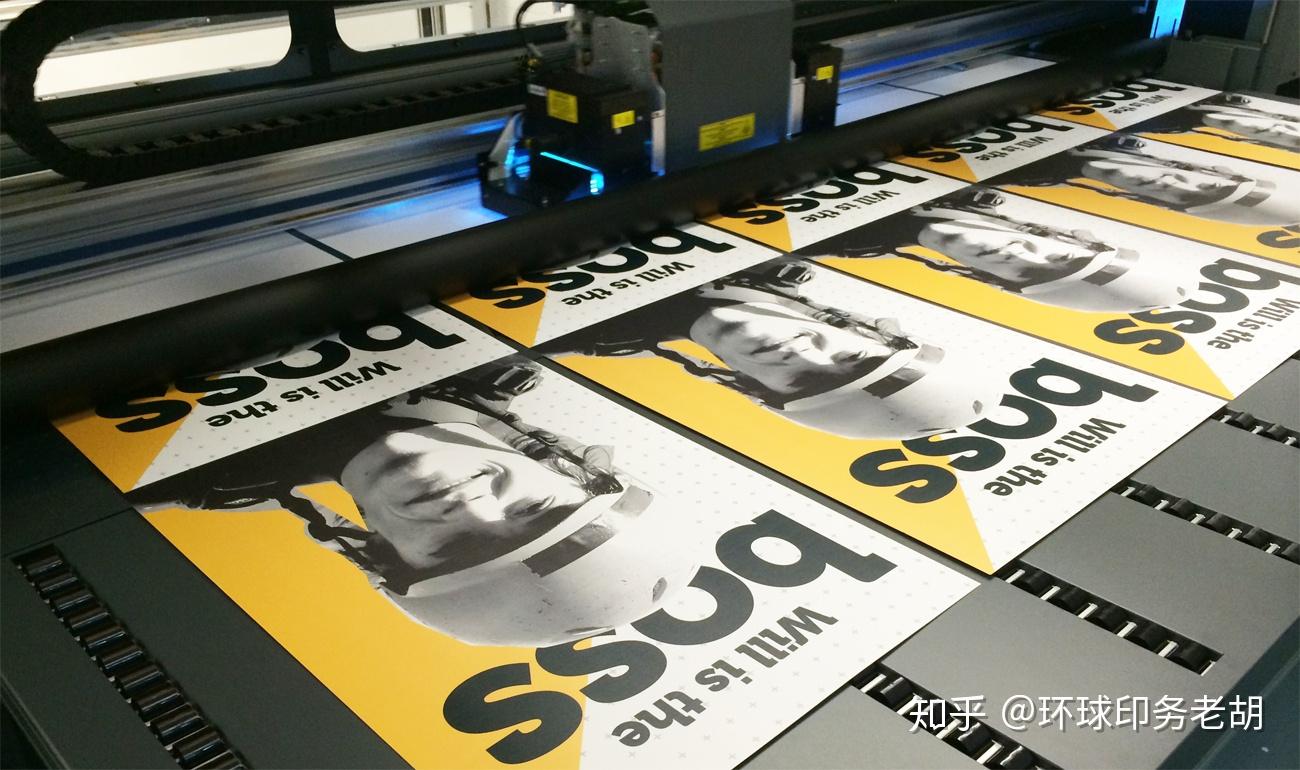
Dot quality improves for the same reason. UV ink cures before it can soak into paper fibers, so dot gain stays low. Images hold their edges and colors stay more saturated, even on uncoated stock where conventional ink normally spreads into the sheet.
Conventional ink depends on the substrate absorbing the oils. Paper and board work. Non-porous surfaces do not, at least not without help.
UV ink bonds to almost anything. Plastics (PET, PE, PVC, BOPP), metallic foils, synthetic labels, glass, acrylic, wood. On film, conventional ink usually needs corona pre-treatment or it peels. UV ink sticks without the extra step.

Per kilo, UV ink costs 20 to 30 percent more than conventional. Some specialty grades run 2 to 3 times higher. If all you look at is the ink price, conventional wins every time.
Total cost of ownership tells a different story in a shop with volume. Instant curing cuts smudged-sheet spoilage by 15 to 20 percent. LED-UV arrays draw far less power than IR drying tunnels or hot-air systems. On the emissions side, conventional ink production and drying releases about 2.1 kg of CO2 per kg of ink. LED-UV systems come in around 0.8 kg CO2 per kg. Whether that matters depends on your regulatory environment and your buyer's procurement requirements, but the gap is there.
Changing the ink changes the press. Every part that touches UV chemistry needs a second look.
Standard rubber rollers and blankets swell and degrade under UV monomers and the aggressive wash-up solvents that clean them. You need EPDM (ethylene propylene diene monomer) rubber throughout the roller train. Some shops run mixed-mode compounds that handle both conventional and UV, but if you are going full UV, swap them all. Urethane grippers also need checking. UV chemistry attacks standard urethane, so budget for replacements there too.
Conventional wash-up solvents will not touch cured UV ink. Mineral spirits do nothing. You need UV-specific wash chemicals, and your automated wash-up system may need its diaphragms and seals replaced to handle the stronger chemistry.
The ink/water balance window tightens noticeably. Operators need more precise control of fountain solution pH and conductivity than a conventional press asks for. A competent pressman adjusts fine. The point is that sloppy dampening that a conventional press shrugs off will punish a UV press with scumming or tinting within a few hundred sheets.
If your press has a coater unit at the end of the line, the tower that applies varnish or coating inline before the sheet hits delivery, that unit needs attention too. UV varnishes and coatings cure differently than conventional oil-based varnishes. You may need a UV lamp after the coater. If the coater's own rollers and blankets are standard rubber, those need to go EPDM as well. Some shops run the coater as a dedicated UV station while keeping the main print units conventional. Others convert the whole line. Either way, do not overlook the coater when quoting the retrofit.
None of this is a dealbreaker. But every item on this list is a cost and a training hour that sits outside the ink quote. Walk into a UV conversion thinking it stops at the ink can, and your press will teach you otherwise within a week.
If you run high volumes on porous paper and every fraction of a cent per sheet matters, conventional offset ink is hard to beat. Most of the world's books, newspapers, and commercial print still run on it for exactly that reason.
UV ink earns its premium when the job demands something conventional cannot deliver. Printing on plastics, foil, or packaging stock that will not absorb oil. Needing same-day turnaround with no spray powder in the workflow. Operating where VOC regulations are tight and getting tighter. In those situations the extra cost per kilo stops looking like a cost and starts looking like access to work you could not take otherwise.